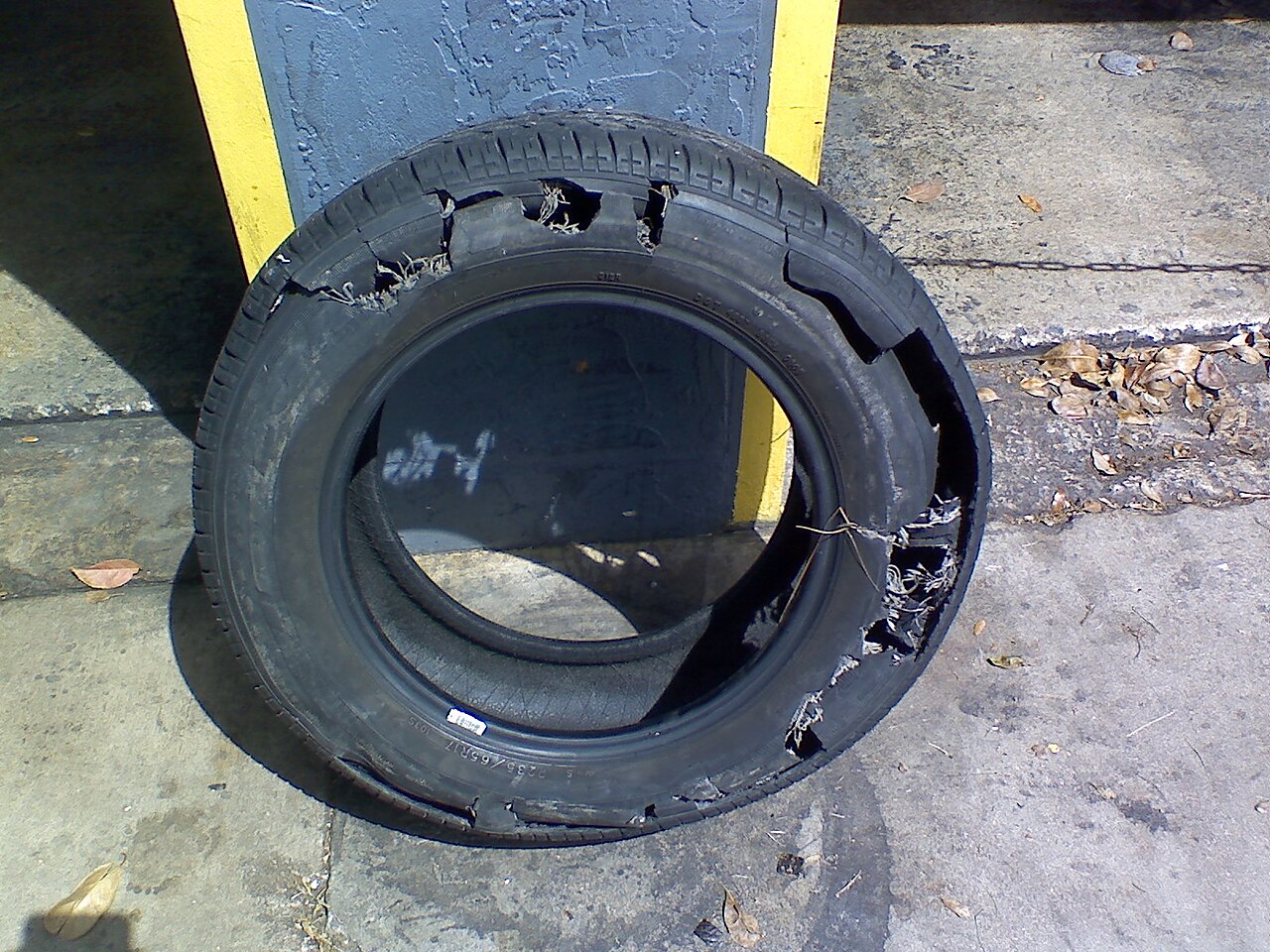
You're rolling west on Flagler at 11 p.m., past the Cuban coffee windows that never close, when the steering gets heavy and the car pulls right. You limp into the lot behind the Versailles bakery, flashlight beam catching a clean slice in the tire's flank — not the tread, the side. That slice isn't a nail hole. It's a death sentence for the tire, and knowing why saves you from a blowout on the Palmetto at 70 mph.
Why is the sidewall different from the tread?
The tread sits flat on the road. It's thick, reinforced with steel belts, and designed to take a plug-patch combo that bonds to the inner liner. The sidewall has a different job: it flexes. Every time the wheel turns, that rubber stretches and relaxes. A typical car tire at 60 mph flexes its sidewall about 800 times per minute. A patch glued to a moving surface peels. A plug pushed through a stretching hole works loose. The physics don't care how good the repair kit claims to be.
What counts as the sidewall zone?
Draw an imaginary line from the edge of the tread face straight down to the wheel rim. Everything outside that line — the vertical face, the curved shoulder, the area that kisses the rim — is sidewall. A puncture 1/4 inch from the tread edge is still sidewall if it's on the curve. The industry rule: if the injury touches the shoulder block or sits outside the major tread grooves, it's a no-go. Measure from the nearest tread groove center. If the damage center is more than 1/2 inch from that groove center toward the rim, it's sidewall territory.
Can a plug get me to a shop?
No. A plug in the sidewall is a time bomb. The plug relies on friction and rubber cement to seal. Sidewall flex breaks that seal in miles, sometimes feet. You'll lose air fast, and a low-pressure sidewall fails catastrophically — the bead unseats, the tire comes off the rim, and you're on metal. I've seen drivers make it three blocks on a plugged sidewall before the tire shredded. Three blocks isn't worth your life.
What about a patch on the inside?
Same problem. A patch needs a stable surface to vulcanize or adhere. The sidewall never stops moving. Heat builds at the patch edge from the flexing, the bond fails, air presses the patch off like a blister. Shops that try it are gambling with your safety. No reputable tire manufacturer approves sidewall repairs. Michelin, Goodyear, Bridgestone — all say replace.
Are there any exceptions for run-flat tires?
Run-flats have reinforced sidewalls that let you drive 50 miles at 50 mph after total pressure loss. That reinforcement makes them stiffer, not repairable. A puncture in a run-flat sidewall still means replacement. In fact, many manufacturers say any run-flat driven flat — even in the tread — must be replaced because the internal structure takes hidden damage. Check your owner's manual; it'll say the same thing.
What does a sidewall cut look like versus a tread puncture?
A tread puncture is usually a round hole — nail, screw, staple. You see the object or a clean dot leaking soapy bubbles. A sidewall injury is often a slice, a gash, or a ragged tear from hitting a curb, debris, or a pothole edge. The rubber fibers pull apart. You might see the white polyester or nylon body cords showing through. That's the tire's skeleton exposed. Once cords show, the tire is done. No debate.
Here's a video that walks through sidewall damage and explains when a tire has to be replaced:
The video covers tire sidewall damage — what it looks like and when replacement is the only safe call. It reinforces the rule above: the sidewall flexes with every rotation, so no plug or patch can hold there the way it can in the tread. Key takeaway: if the injury sits on the sidewall, the tire gets replaced, not repaired.
What if the tire is new or expensive?
Price doesn't change physics. A $400 Michelin Pilot Sport with a sidewall slice gets replaced same as a $80 budget tire. Some dealers offer a prorated credit if the tire is under warranty and the damage is a manufacturing defect — but road hazard isn't a defect. Your wallet hates it, but your family needs you alive. That's the math.
Can I just put a tube in it?
Tubes in tubeless tires are a bad idea on the sidewall. The tube presses against the cut from inside. Every flex pinches the tube against the sharp edges of the gash. It wears a hole in the tube fast. Plus, tubeless tires aren't designed for tubes — the valve stem hole isn't reinforced for tube friction, and heat builds differently. Don't do it.
What should I do right now if I find one?
Don't drive on it. Not to the shop, not around the block. Put the spare on or call a mobile service. If you're on Flagler, on the Palmetto, stuck in a Kendall driveway at midnight — stay put. A mobile tire truck brings the tire, mounts it, balances it, and torques the lugs to spec right where you sit. You don't risk a blowout. You don't tow. You wait in the AC.
When to call us
If you see a cut, slice, bulge, or exposed cords on the tire's side — call Flat Tire Miami at (786) 551-9398. We run Monday through Friday 5 p.m. to 7 a.m., Saturday and Sunday 24 hours, anywhere in Miami-Dade County. We bring the tire, the tools, and the torque wrench. You stay safe.