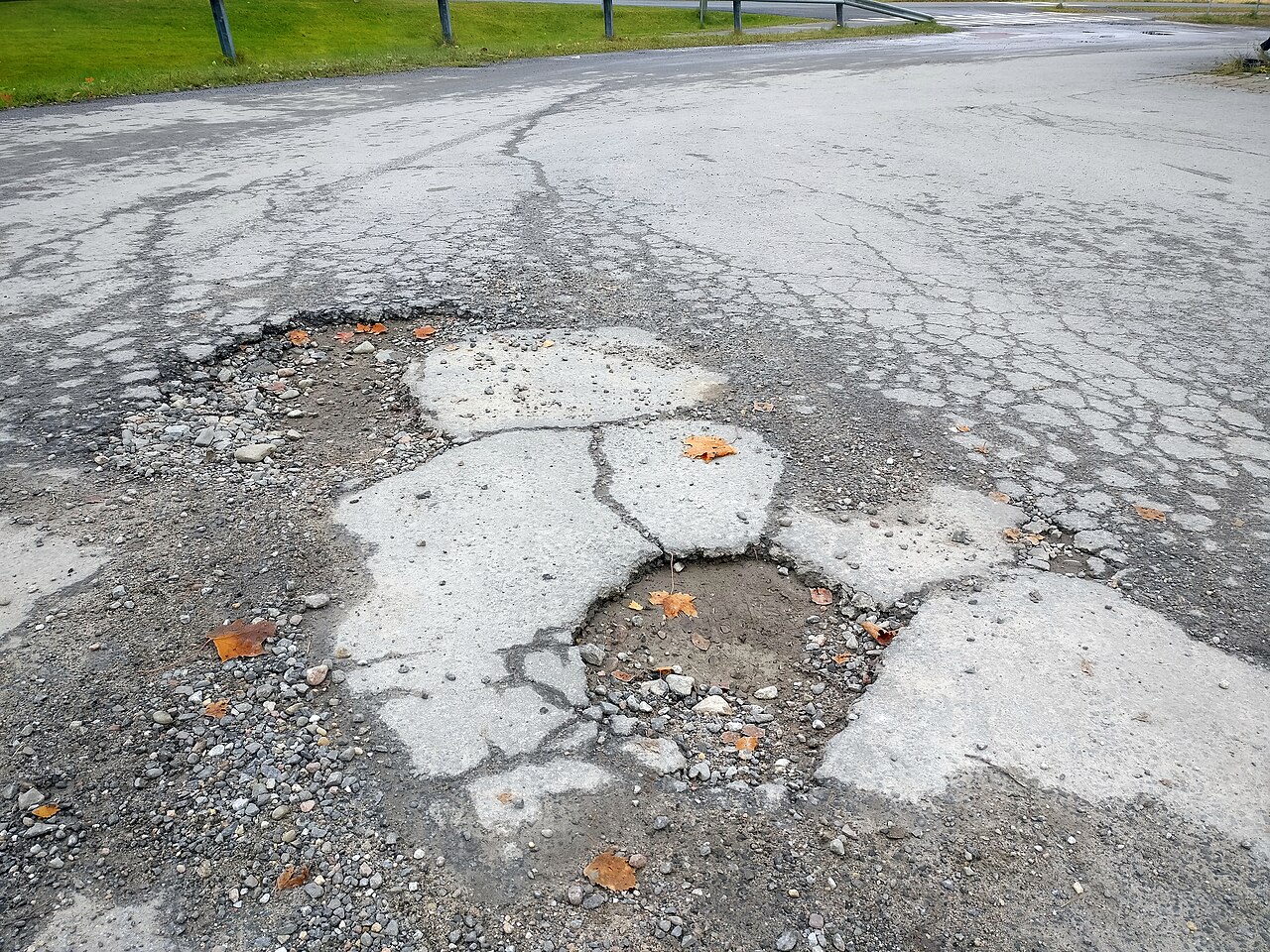
 The rain stopped twenty minutes ago, but the puddle at the corner of Northwest 7th Avenue and 36th Street still hides a crater the size of a dinner plate. You're rolling west toward the Palmetto at 35 mph, coffee in the cupholder, when the front passenger wheel drops in. The impact travels up the steering column — a sharp *thunk* you feel in your wrists. No blowout, no immediate pull. You keep driving. Two days later you notice a slow leak and a hairline crack in the rim lip. That's how pothole season works here: the damage shows up on its own schedule.
Why does Miami get so many potholes each year?
Our limestone base doesn't drain like the sandy soils up north. Rain seeps into tiny cracks and softens the base underneath. Every tire that rolls over the wet spot pumps a little more water — and a little more of that softened base — out from under the asphalt. The surface loses its support, flexes, and starts to break up. Heavy trucks on US-1 and the Dolphin finish the job. City patches settle, crack, and become the next generation of holes.What kind of tire damage does a pothole cause?
Three main injuries. First, a sidewall pinch — the tire compresses against the rim edge, slicing the inner liner. You won't see it from the outside. The tire holds air for days, then goes soft. Second, a tread separation — the impact breaks the bond between belts. You'll feel a wobble at highway speed, like a slow shake in the steering wheel. Third, a bead damage — the tire's sealing edge gets nicked. Air leaks slow and steady, often mistaken for a valve-stem problem.How do I know if my rim is bent or cracked?
Steel rims bend. Aluminum rims crack. After a hit, run your hand along the inner and outer lip of each wheel — feel for a sharp edge or a flat spot where the curve should be. Spin the wheel by hand (car jacked up, obviously) and watch the rim face. A bent rim wobbles side to side. A cracked rim may not wobble but will leak air at the fracture. Look for hairline lines radiating from the bolt holes or the valve stem. If you see powdery white corrosion around a line, that crack has been weeping for a while.Can I drive on a slightly bent rim?
Short answer: not far. A bent rim flexes every rotation. That flex fatigues the metal and works the tire bead loose. You'll burn through a tire in a few hundred miles. The vibration also hammers wheel bearings and tie-rod ends. If the bend is minor — less than an eighth of an inch runout — a shop can often straighten it on a hydraulic press. But if the rim is cracked, it's done. No welding aluminum wheels safely. Replace it.What should I check right after hitting a bad pothole?
Pull over safely. Walk around the car. Look at all four tires — sidewalls, tread face, valve stems. Check the rims for fresh scrapes or cracks. Turn the steering wheel lock to lock; listen for clunks or binding. Drive slowly in a straight line: does the car pull left or right? Does the steering wheel sit off-center? Any yes means alignment shift. Check pressure on all four tires with a gauge, not the dash light. A slow leak takes hours to trigger TPMS.How does alignment shift after a pothole hit?
The suspension links — control arms, tie rods, strut mounts — are built to absorb up-and-down motion. A sharp horizontal hit from a pothole edge pushes those links sideways. The metal yields a fraction of a degree. That's enough to change toe (tires pointing in or out) or camber (top of tire leaning in or out). You'll see inside-edge wear on the front tires within 2,000 miles. The car pulls. Fuel economy drops because the tires scrub. An alignment check costs less than a pair of tires.Why do potholes feel worse at night?
You can't see them. Headlights reflect off wet pavement and hide depth, so a puddle looks flat until you're in it, and you brake later and hit harder. The same hole that's a bump at noon becomes a rim-bender at 10 p.m. Slow down on known bad corridors — Northwest 27th Avenue, Southwest 8th Street, the service roads along I-95 — especially after rain.What the video shows
This is what a pothole-bent aluminum wheel looks like off the car. 6th Gear Garage repairs one in his garage — heat, a bottle-jack press, then a file and sandpaper for the curb rash. Watch it for the diagnosis, not as a driveway assignment: the bend he starts with is the same flat-spot wobble described above, and the amount of force it takes to move the metal back is the point. A rim that needs this much work does not get fixed with a mallet in a parking lot, and a cracked rim does not get fixed at all. If your wheel looks like his starting point, the wheel comes off and the car sits until a shop press — or a replacement wheel — sorts it.
Can proper tire pressure prevent pothole damage?
It helps, but it's not armor. Correct pressure keeps the sidewall stiff enough to share the hit with the rim. Underinflated tires fold over the rim edge — that's where pinch flats and bead cuts happen. Overinflated tires have no give; the rim takes the full shock. Check pressure when tires are cold, first thing in the morning. Use the door-jamb placard, not the max PSI on the tire sidewall. In Miami heat, pressure climbs 2–3 PSI from morning to afternoon. That's normal. Don't bleed it off hot.Do certain tires handle potholes better?
Taller sidewalls absorb more. A 65-series tire on a 17-inch wheel has more cushion than a 40-series on a 20. Run-flats have reinforced sidewalls but ride harsher and transmit more shock to the rim. All-season touring tires generally have thicker sidewalls than ultra-high-performance summer tires. If you're shopping for tires and you drive these corridors every day, that sidewall height is worth more than a sporty look. Whatever you run, the cheap protection is boring: correct pressure, a monthly walk-around with a gauge, and a real inspection after any hit that made you wince.When to call us
DIY is great, but some jobs need a pro. If the problem persists, you spot anything dangerous, or you'd rather have an expert handle it, call (786) 551-9398 — Flat Tire Miami serves Miami-Dade County (Mon-Fri 5PM-7AM, Sat-Sun 24H). No pressure, no upsells.