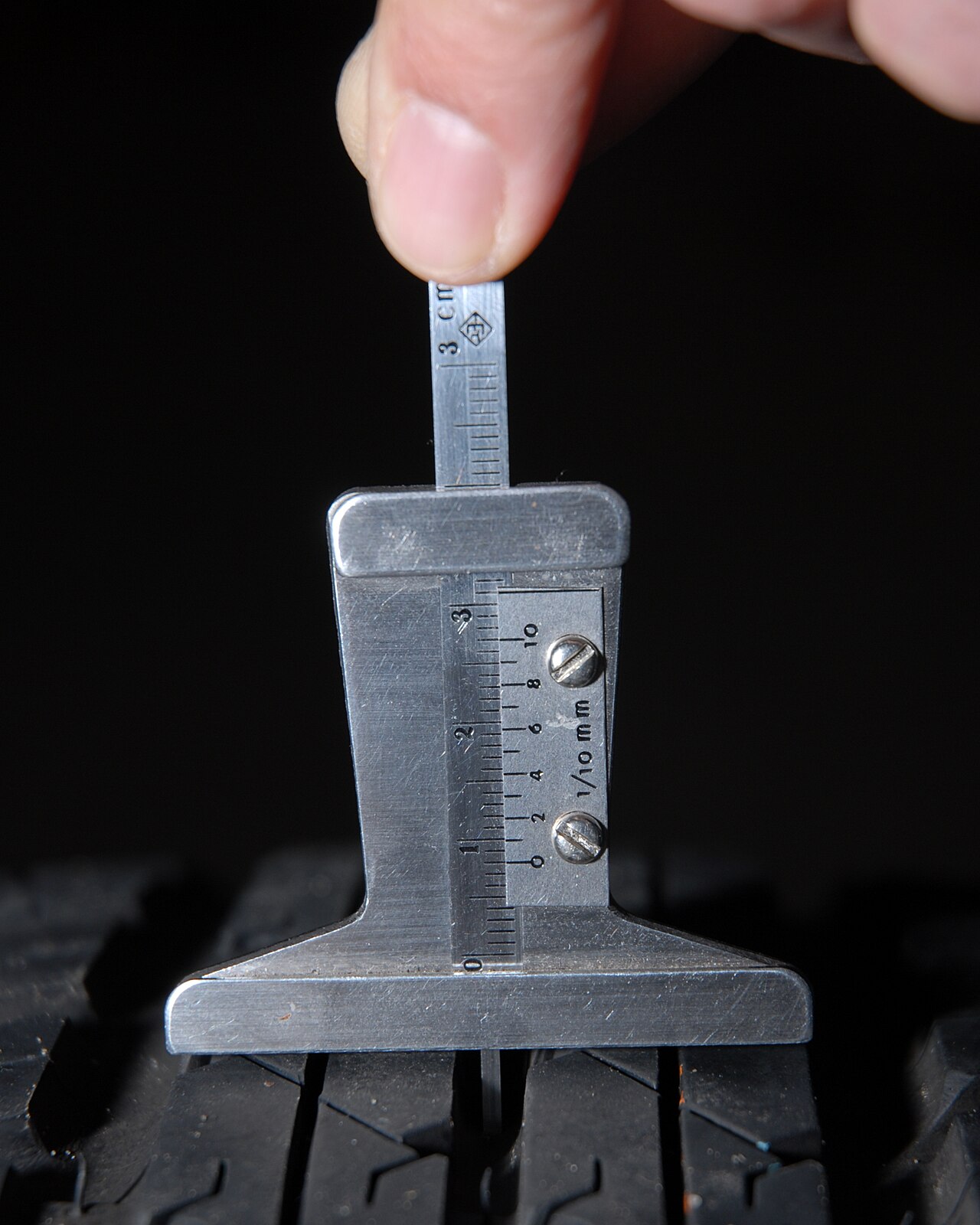
 It's 6:15 a.m. on a Tuesday, and you're standing in the driveway off Coral Way with a travel mug in one hand and a penny in the other. The car's packed for the drive up I-95 to Fort Lauderdale — kids' bags, cooler, the works. You've heard the old trick: stick Lincoln's head in the groove, and if you see his whole head, the tire's done. But the tread looks uneven across the shoulder, and the penny gives you a yes-or-no answer when what you really need is a number. The gauge sitting in the glove box has been there since the last oil change, still in the plastic. This is the morning you finally learn to read it.
Why isn't the penny test enough?
The penny test only tells you whether the deepest groove has crossed the 2/32" line. It doesn't show you if the inside shoulder is worn to 3/32" while the center sits at 6/32". That split happens all the time on Miami cars — alignment drifts from potholes on Bird Road, or the camber shifts after a curb tap near Dadeland. A gauge reads each spot separately. You'll see the difference between 4/32" and 5/32" in the rain on the Palmetto: the deeper groove still pushes water out; the shallower one lets the tire surf.
What is a tread depth gauge?
A tread depth gauge is a small tool that measures groove depth in 32nds of an inch (or millimeters). Two common types exist: a stick gauge with a sliding ruler and a digital gauge with an LCD screen. Both have a probe that drops into the tread groove and a base that rests on the tread blocks. The probe extends until it hits the bottom of the groove. The scale or screen shows the depth. No batteries required for the stick version; the digital type usually runs on a coin cell that lasts years.
How do you use a digital gauge, step by step?
Turn the gauge on. Most models default to 32nds of an inch — press the unit button if it shows millimeters. Place the base flat on two adjacent tread blocks so the probe hangs over the groove. Press the zero button if your gauge has one; this sets the current position as zero. Gently push the probe down until it bottoms out in the groove. Don't force it — the probe slides on its own spring. Read the number on the screen. Move to the next groove, press zero again, and repeat. Check three grooves across the tread: inside shoulder, center, outside shoulder. Write down each reading.
How do you use a stick gauge, step by step?
Hold the gauge by the barrel with the probe pointing down. The sliding ruler sits inside the barrel, marked in 32nds. Place the base foot on two tread blocks so the probe aligns with a groove. Push the probe straight down until it stops. The ruler slides out of the barrel. Pinch the ruler at the barrel's edge to lock the reading, then pull the gauge out and read the number where the ruler meets the barrel. If the ruler shows "4" at the top of the barrel, that's 4/32". Repeat across the three grooves. Wipe the probe clean between tires so grit doesn't scratch the next reading.
What do the numbers mean?
New passenger tires start around 10/32" to 11/32". At 6/32", you have plenty of life left for dry roads and moderate rain. At 4/32", wet braking distance starts to climb — plan replacement soon. At 3/32", hydroplaning risk jumps noticeably on standing water. At 2/32", you're at the Florida legal limit and the wear bars (raised ribs molded into the groove bottom) are flush with the tread blocks. If any groove reads 2/32" or less, the tire is legally bald. Uneven readings — say 5/32" center, 3/32" inside — mean an alignment or rotation issue, not just wear.
Where should you measure on the tire?
Don't just check one spot. Measure three grooves per tire: the inside shoulder groove (closest to the car), the center groove, and the outside shoulder groove. On directional tires, the grooves run the same way all around — pick any three evenly spaced grooves. On asymmetric tires, the inside and outside tread patterns differ, so you must check both shoulders. Rotate the tire by hand or roll the car forward a foot to reach fresh grooves. Check all four tires. The spare, if it's a full-size, gets checked too.
How often should you check tread depth?
Check once a month and before any long trip. Heat accelerates wear — July pavement in South Florida can push rubber far past its comfort zone, and that softens the tread fast. A tire that measured 5/32" in March can hit 3/32" by August. Pair the check with your pressure check: same day, same routine. Keep the gauge in the door pocket or glove box so it's there when you need it.
Here's a video walkthrough of checking tread depth with a gauge:
The video above walks through the gauge technique shown in this guide.
When to call us
DIY is great, but some jobs need a pro. If the problem persists, you spot anything dangerous, or you'd rather have an expert handle it, call (786) 551-9398 — Flat Tire Miami serves Miami-Dade County (Mon-Fri 5PM-7AM, Sat-Sun 24H). No pressure, no upsells.