 The vibration started somewhere around Northwest 79th Street on a humid October afternoon, a steady shake in the steering wheel that got worse every time you hit 45 mph. You'd sworn you missed that pothole near the Metrorail crossing, but the front passenger wheel tells a different story. Now you're pulled into the parking lot behind the Publix on 79th and 27th, engine off, hazard lights flashing, wondering if the rim took the hit or if it's just a balance weight gone missing. The afternoon heat radiates off the asphalt, and the smell of exhaust from the Palmetto drifts over the fence. You need to know before you roll another mile.
What does a bent rim feel like when driving?
A bent rim usually announces itself through the steering wheel first. You'll feel a rhythmic shake that matches your speed — faster shake at higher speeds, slower at lower speeds. It's not the same as an unbalanced tire, which tends to show up around 55–65 mph and then smooth out. A bent rim vibration often starts lower, sometimes as early as 30 mph, and doesn't go away. You might also hear a faint thump-thump-thump from the wheel well, like a flat spot on the tire hitting the pavement each rotation. If the bend is on the inside of the rim, you might not see any damage at all. That's why the spin test matters — it shows what your eyes can't.What tools do you need for the spin test?
You don't need a shop lift. You need a floor jack rated for your vehicle's weight, a jack stand (never work under a car on just a jack), and a lug wrench or impact gun to remove the wheel. A piece of chalk or a zip tie helps mark the high spot. A ruler or tape measure with 1/16-inch markings lets you quantify the wobble. If you have a dial indicator, great — but most people don't. A simple trick: clamp a zip tie to a stable part of the suspension or brake caliper bracket so the tail nearly touches the rim's bead seat. Spin the wheel. The gap changes where the rim wobbles. Listen for the zip-tie tail ticking once per turn as the high spot passes — that tick is the bend announcing itself. Measure that gap with your ruler. That's your runout number.How do you do the spin test step by step?
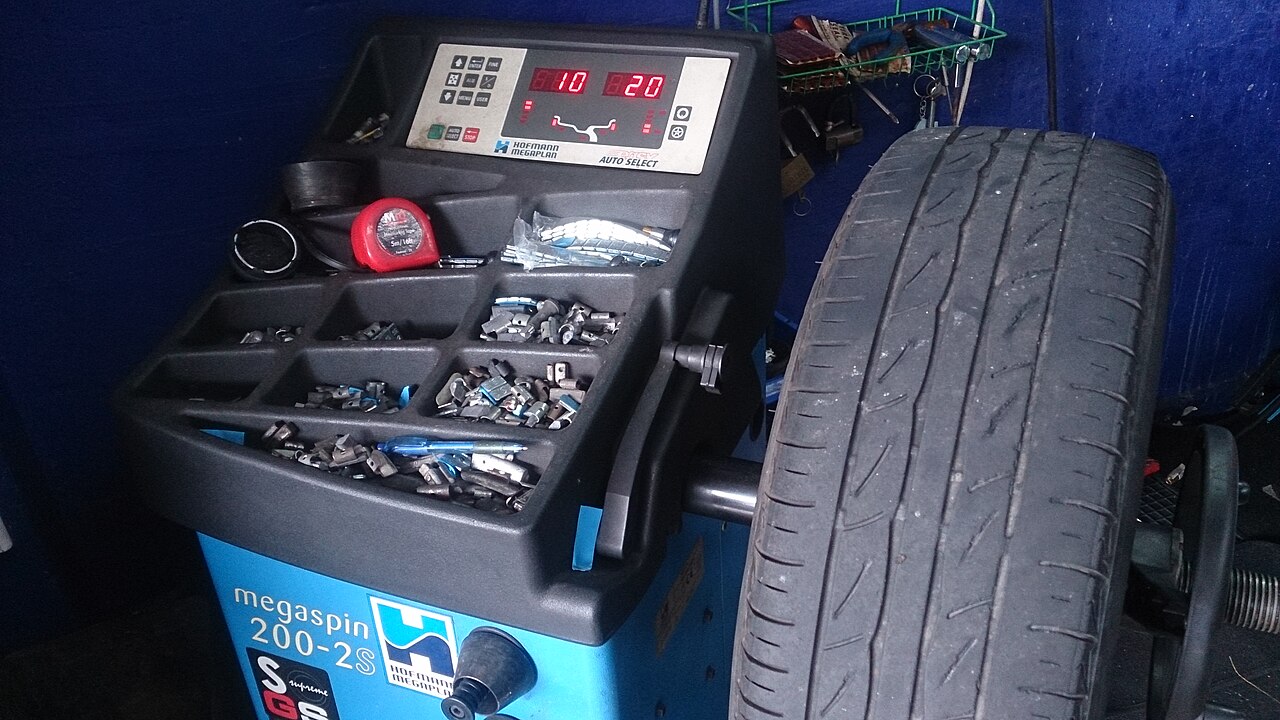
Park on flat concrete. Engage the parking brake. Chock the rear wheels if you're lifting the front, or the front wheels if you're lifting the rear. Loosen the lug nuts one turn while the wheel is still on the ground. Jack up the car at the factory jack point — check your owner's manual for the exact spot. Place a jack stand under a solid frame rail or control arm mount. Lower the car onto the stand. Remove the lug nuts and pull the wheel off. Now you have the bare rim (or rim with tire mounted) in your hands. Set the wheel on a flat surface — a workbench, two sawhorses, or even the ground if it's clean and level. Spin it gently by hand. Watch the inner and outer bead seats — the flat surfaces where the tire seats. Look for side-to-side movement (lateral runout) and up-and-down movement (radial runout). Use the zip-tie method or hold a ruler against a fixed point and watch the gap open and close. Mark the worst spot with chalk. Measure the total movement at that spot. Write it down. Repeat for the other side of the rim. If the tire is still mounted, you're measuring the assembly, not just the rim. A tire with a shifted belt can mimic a bent rim. That's why shops use a balancer — it separates the two.How much wobble is too much?
Most manufacturers spec lateral runout at 0.030 inch (about 1/32 inch) and radial runout at 0.040 inch for steel rims. Aluminum alloy rims are held tighter — often 0.020 inch lateral, 0.030 inch radial. Think of it like a dinner plate on a table. Lateral runout is the plate's edge wobbling side to side while the plate stays at the same height — the rim snakes left and right as it turns. Radial runout is the plate's edge rising and falling — the rim hops up and down, like a wheel with a flat spot. A wobbling plate still holds dinner; a hopping plate spills it. The spin test catches both, which is why you watch the bead seat from the side AND from above. In the field, we use a practical rule: if you can see the wobble with your naked eye while spinning by hand, it's likely out of spec. A 1/16-inch lateral wobble (0.0625 inch) is definitely bent. A 1/8-inch radial hop (0.125 inch) is definitely bent. Anything between "barely visible" and those numbers is a judgment call. If the vibration started right after a pothole hit, and you measure more than 1/32 inch lateral, treat it as bent. The risk of a sudden air loss at highway speed isn't worth guessing.Can you drive on a slightly bent rim?
Short answer: not safely. A bent rim creates a stress riser — a concentrated spot where the metal fatigues faster every rotation. Heat builds there. The tire bead doesn't seat evenly, which means slow leaks or sudden separation. At 70 mph on I-95, a compromised bead can let go in a fraction of a second. You'll feel the car pull hard to one side. If that happens in the left lane with traffic on your right, you have nowhere to go. Even if it holds air, the vibration wears wheel bearings, tie rods, and ball joints prematurely. A $200 rim repair now beats a $1,200 suspension repair later. If you must move the car a short distance — like from the travel lane to a parking lot — keep it under 20 mph and put your hazards on. That's it.Why does the spin test work better than just looking?
Your eye catches big dents. It misses a rim that's ovaled out from a hard impact but shows no crease. The spin test reveals runout — the geometric truth of whether the rim rotates in a perfect circle. Think of a bicycle wheel with a bent spoke. The rim pulls toward the tight spoke and away from the loose ones. Spin it, and the rim snakes side to side. Same physics at 3,000 pounds. The zip tie or ruler gives you a number. Numbers don't argue. A visual inspection is a guess. The spin test is a measurement.While the wheel is jacked up for the spin test, check the tread for a puncture too. Slow leaks can masquerade as balance or rim problems, and the spin test puts you in exactly the right position to find a nail or screw. The video below shows the other common DIY fix you might reach for.
The video is "DIY: Plugging a Tire Leak" by the independent automotive DIY creator 4DIYers. It demonstrates the classic do-it-yourself puncture repair: plugging a tire leak with a plug kit — the kind of repair many drivers handle in their own garage rather than calling for a tow. Why it's here: this article's spin test starts with jacking up the car, and that's the same position you need to be in to spot a puncture in the tread. A slow leak changes how a tire feels at speed, and ruling a puncture in or out costs nothing while the wheel is already off the ground. Watch it before you buy a plug kit — and note the important boundary it reinforces: plugs fix tread punctures, not bent rims and not sidewall damage.
When to call us
DIY is great, but some jobs need a pro. If the problem persists, you spot anything dangerous, or you'd rather have an expert handle it, call (786) 551-9398 — Flat Tire Miami serves Miami-Dade County (Mon-Fri 5PM-7AM, Sat-Sun 24H). No pressure, no upsells.
One honest limit: we don't straighten rims in driveways. If your spin test shows a real bend, the rim needs a wheel repair shop with a straightening machine — or a replacement. Call us for the tow, the spare swap, or getting you rolling again safely.