Northbound on the Palmetto at 5:47 on a Thursday, the sun dropping behind the Hialeah warehouses, you're doing 55 with the AC on full blast. Then the steering wheel starts shuddering — a fast little side-to-side tremble you feel in your fingertips before you even glance at the speedometer. No pothole. No debris. Just the wheel, buzzing like it wants to jump out of your hands.
What does an out-of-balance wheel actually feel like?
A bad balance is a buzz, not a thump. If it's a front wheel, the steering wheel trembles left and right in your hands — fast and steady, like a phone vibrating on a table. If it's a rear wheel, you feel it in the seat cushion under your thighs and in the floorboards. Either way the pitch climbs with speed: a low tremble at 40 becomes a high-frequency hum by 65. Your coffee ripples in the cup holder. The rearview mirror image jiggles just enough to blur.
A single thump-thump-thump is a different animal — that's usually a bent rim or a separated tire belt, not a balance problem. Balance shakes are smooth and constant. They don't change with bumps or turns. They only care about one thing: how fast the wheel is spinning.
Why does the shake come and go with your speed?
Think of your washing machine on spin cycle with one heavy wet towel clumped on one side of the drum. Slow spin: the drum wobbles a little and you barely notice. Full-speed spin: the whole machine walks across the laundry room and bangs the wall. Nobody added weight. Speed did.
Your wheel works the same way. Every tire-and-wheel assembly has a small heavy spot. Each time the wheel turns, that spot slings outward and tugs the car once. Here's the math on a typical 25-inch tire: circumference is π × 25, about 78.5 inches — call it 6.5 feet. At 60 mph you're covering 5,280 feet every minute. Divide 5,280 by 6.5 and you get roughly 807. Your wheel spins about 800 times a minute at 60 mph, and the heavy spot tugs outward on every single spin. Eight hundred tiny tugs a minute is exactly why it feels like a buzz instead of a bump. Drop to 30 mph and the tugs come half as often with a quarter of the force, so the shake just vanishes.
Still fuzzy? Picture a merry-go-round.
Same idea, playground version. A merry-go-round with all the kids piled on one side spins fine when you push it slow — it creaks around and nobody notices the lopsided load. Spin it fast and the whole frame shudders, the center post strains, and every kid feels it. The imbalance was there the whole time. Speed turned it into a problem. That is exactly what happens inside your wheel: a quarter-ounce heavy spot that means nothing at 20 mph becomes a steering-wheel earthquake at 55.
How do you run the DIY road test?
Find a smooth, straight stretch with light traffic — the repaved part of US-1 through Cutler Bay early in the morning works, or any wide empty lot. Roll up gently: 20, then 30, then 40, 50, 60. Note the exact speed where the tremble first shows up. Hold that speed for ten seconds. Does the shake stay steady, grow, or fade? Now slow back down through the same speeds. A true balance problem appears inside a band and disappears below it. If the shake is there at every speed, it's something else — likely a bent rim or a damaged tire.
Hands or seat tells you front or rear. Tremble in the wheel means a front tire. Buzz in the seat and floorboards means a rear one. Both at once means you've got more than one wheel out — common after a curb strike on the same side.
Before you blame balance, rule out the cheap stuff. Walk around and check that every lug nut is snug — a loose wheel shakes exactly like a bad balance and it is dangerous. Torque them to your owner's manual spec with a real torque wrench, not just "tight." Check your pressures too, because a soft tire rides rough and muddies the whole test.
Stay safe doing this. Never run the test on the shoulder of an expressway — that's our job to rescue you from, not your test track. Keep up with traffic, and flip your hazards on if you drop well under the flow.
What knocks a wheel out of balance in the first place?
Clip-on wheel weights corrode and fling off — salt air eats them alive down here, sometimes within a year or two. A curb kiss on a tight Hialeah turn. Any new tire, which always needs a fresh balance on day one. And the sneaky one: mud caked inside the rim barrel after an October downpour. A half-pound of wet mud stuck on one side of the rim is a genuine imbalance, and a $2 car-wash rinse fixes it. Uneven wear from skipped rotations adds to the pile over time.
What can a road test NOT tell you?
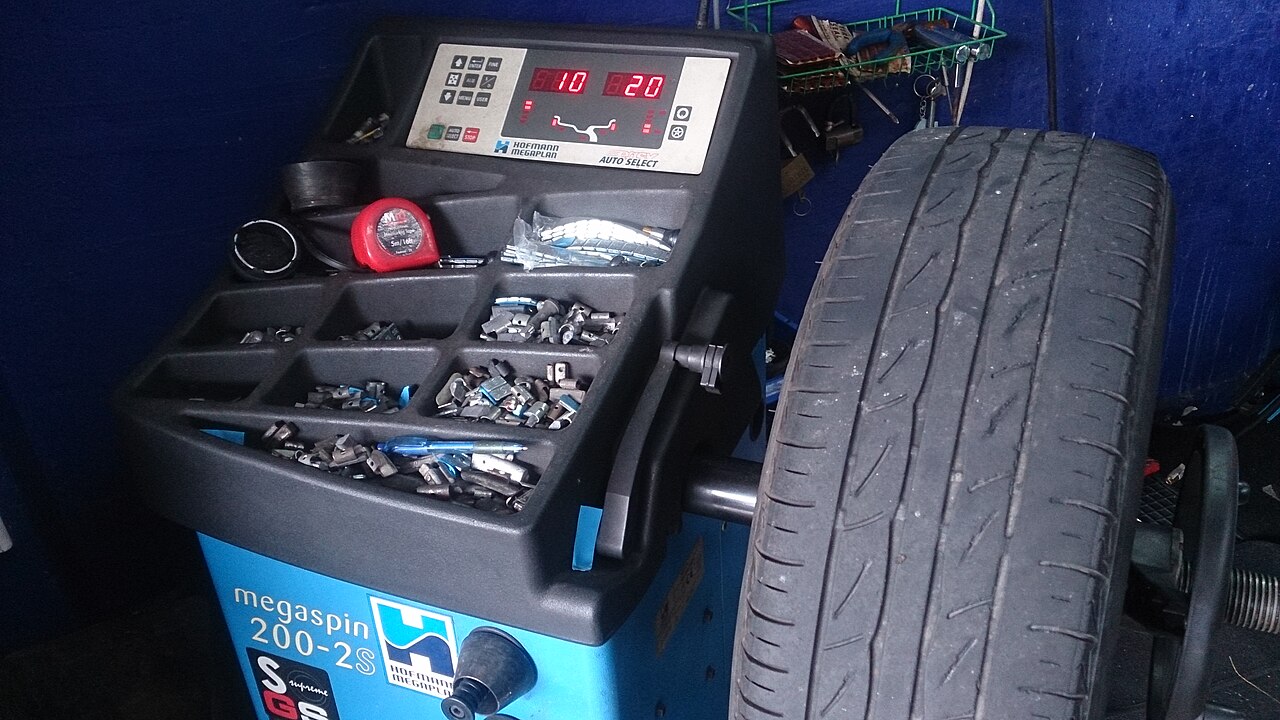
Your road test says "something's off" but it can't say which wheel, how much weight it needs, or whether the rim is bent. That takes a spin balancer: the shop spins the assembly at highway speed, the machine reads the wobble in ounces, and the tech sticks weights — usually in quarter-ounce (0.25 oz) chunks — on the rim until it spins true. It also checks runout, the side-to-side wobble of the rim itself, which no amount of weight can fix.
Two terms worth knowing. Static balance is up-and-down hop: a statically bad wheel always stops with the heavy spot pointing down, like a loaded die. Dynamic balance is the side-to-side shimmy that only shows up at speed. Your road test mostly catches the dynamic kind.
When to call us
If the shake is bad enough that you don't trust the car, or it's 2 AM and you're on the shoulder of the Palmetto, call Flat Tire Miami at (786) 551-9398. We run mobile across all of Miami-Dade County — Mon–Fri 5PM–7AM, weekends 24 hours. We'll come to your pin, mount your spare (the swap is $65 flat), or plug a nail if the tire is salvageable, and get you rolling. No tow needed.
And the honest part — don't call us for these. A spin balance in your driveway: our trucks don't carry a balancer, and we'll tell you so instead of selling you a guess. An alignment. Or a shake that only shows up when you brake — that's rotors, not balance, and it belongs at a brake shop.